
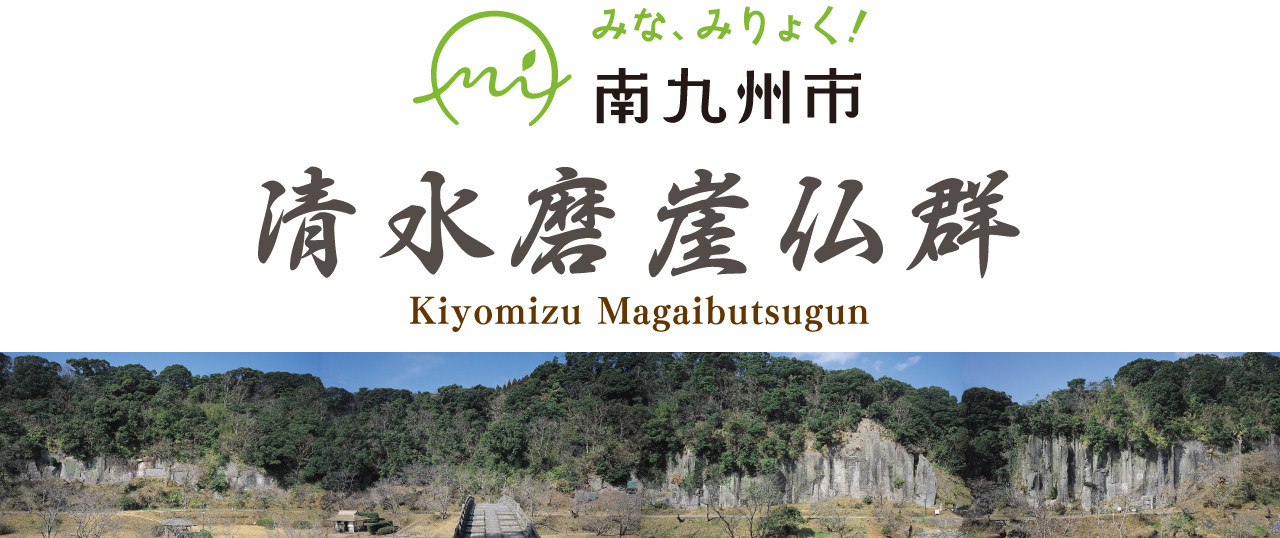
Kiyomizu Magaibutsugun

In front of you flows the Manose River. Running through Kawanabe Town and Fukiage Beach, it pours into the East China Sea.
As you can see along this river, rocky mountain walls rise 20 meters into the sky, creating a dynamic and mysterious scene.
On these rock walls, 202 Buddhist carvings have been found. Called Kiyomizu Magaibutsu, this series of sculptures feature mostly stupas called Gorin-to or Houkyouin-to. What makes this site unique is the continuous carving process carried out for about 800 years, from the mid 12th to the late 19th Century.
Currently, Iwaya Park lends this area a refreshing atmosphere. However, in the old days, it must have been a dark, mystical forest. This land held a special meaning for the people of Kawanabe.
All the sculptures may look the same, but as you stroll around, taking a closer look, you will gradually discover some changes along their history of prayer.
Please observe each sculpture and immerse yourself in the history of 800 years of continuous Buddhist carving.
1.Houkyouin Stupa Carved in 1296
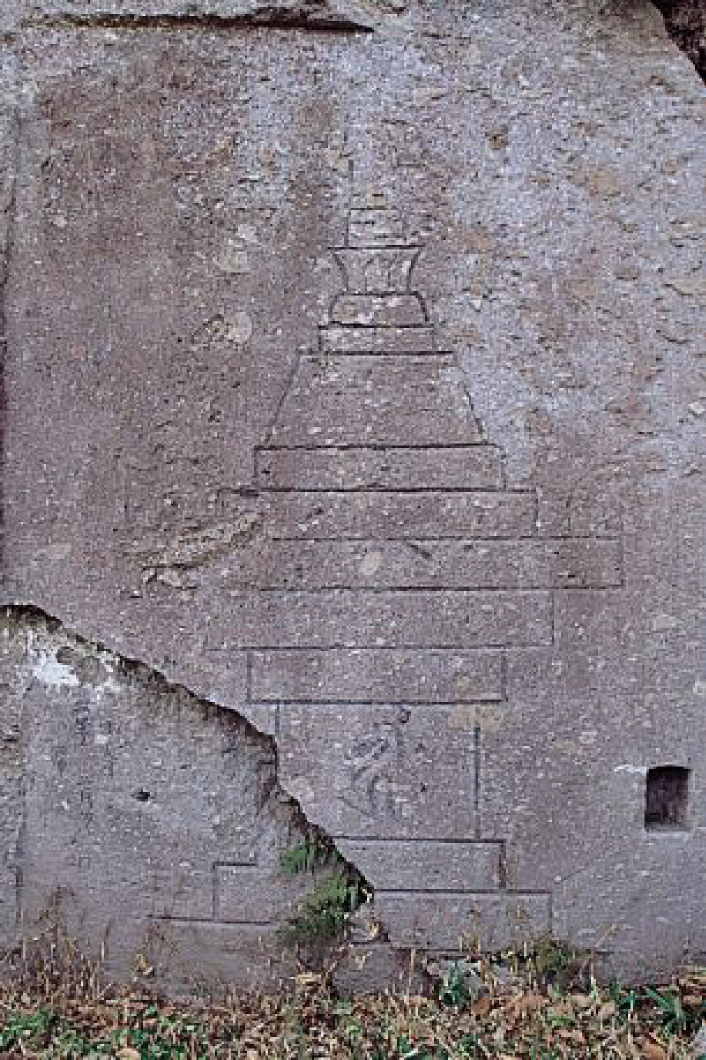
On the cliffside above you, a stupa called Houkyouin-to has been sculpted. The record says it was sculpted on February 28th of 1296. Unfortunately, you cannot see it from here.
Please move two steps to the right from this explanation board. Can you find a large rock wall with a brown left side? The stupa is sculpted at the bottom of that rock, along with a description of the reason for this carving. According to this explanation, the stupa was dedicated to a Buddhist memorial service held thirty-five days after the death of a woman called Syoujo.
Besides this stupa carved in 1296, there is a group of three other stupas found upstream with a description saying, “These stupas are dedicated to Syoujo for the Buddhist memorial service held forty-nine days after her death.”
The discovery of multiple stupas tells us that by the Kamakura period, it was common for Buddhist ceremonies to be held every 7th day after a person’s death. Can you feel the faith of Buddhist believers living over 700 years ago?
2.Stupas from the Kamakura Period
The stupas you can see from here were the ones carved in the Kamakura Period. This period was from the early 13th to the early 14th Century. They are Houkyouin-to or Gorin-to stupas all carved in lines on the wall.
Do you mind moving 8 steps to the right?
Looking up from here, you can observe the two Houkyouin-to and a Gorin-to.
These Houkyouin-to are carved in combinations of straight horizontal and vertical lines.
To the right of these, is the Gorin-to, a stupa with a trapezoid roof and a ball sitting on a square pedestal.
By the way, can you see an open hole on its pedestal?
The reason for this hole is unknown. However, in 2017, a Houkyouin-to with a closed hole was discovered. When the cover of this hole was removed, cremated human bones were found inside.
Until recently, people believed that Kiyomizu Magaibutsu was only created for conducting Buddhist ceremonies. This discovery brought new evidence proving that it was also a place to lay ashes to rest.
There are a couple more open holes found in this series of Kiyomizu Magaibutsu sculptures. It is possible that these holes held human remains.
3.Dai Gorin-to
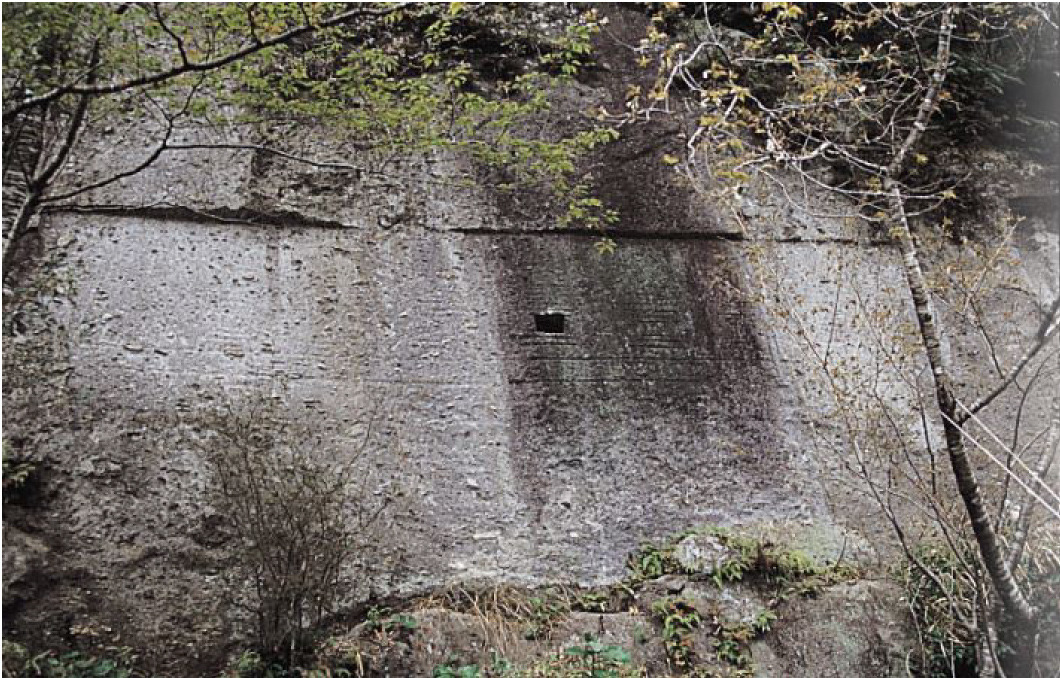
Across the river, on the right side of the outdoor lamp is an explanation sign. Carved on the cliff wall standing behind the sign is the Dai Gorin-to. Can you see the engraved circle on the wall?
Thought to have been created around the end of the 12th or the beginning of the 13th Century, it is the oldest and largest of all Kiyomizu Magaibutsu rock carvings.
Since it is difficult to see from here, let me tell you about it, according to this explanation board.
The illustration in the center of this board is an estimated reproduction of the stupa. Standing 11 meters high, it is engraved like this carving on the rock wall.
On the back of this stupa is carved a pentagonal frame enclosing the Dai Gorin-to. Within this frame, there is a grid containing over 5,000 Sanskrit characters, probably consisting of a sutra. Sumi ink was used to paint these characters inside each 10-centimeter square.
While we can hardly read the Sanskrit characters anymore, the remains of the ink can be seen.
The reason for its creation, as well as its sculptor, remain unknown. However, it is believed that the stupa expresses excellent Buddhist tenets.
4.Stupas from the Muromachi Period
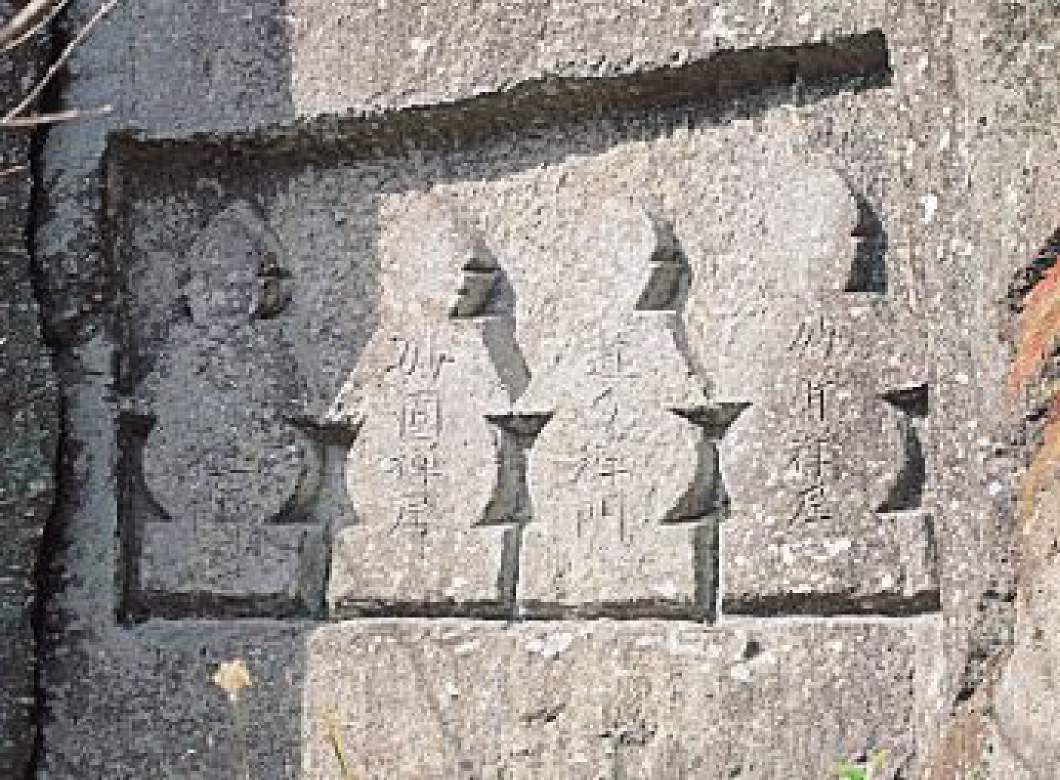
Can you see the three Sanskrit characters, each contained in circular representations of the moon? Those are called Gatsurin Dai-Bonji. Underneath these is Renkoku-Itabi, multiple stupas contained in a rectangular window.
Below these are Gorin-to stupa reliefs, which look small from here. They were sculpted in the Muromachi Period, from the early 14th to the mid 16th Century.
Most Magaibutsu sculpted in the Muromachi Period are Gorin-to stupa reliefs. What distinguishes these sculptures from those of other eras is that these are mostly reliefs, not engraved lines. And they are all rather small in size.
The original purpose of creating stupas was dedicating them to the dead at their memorial services. However, among stupas from this age, some were sculpted before death. There are also stupas carved with the names of married couples.
Observe how people’s customs and ways of thinking changed over 800 years of stupa carving in Kiyomizu.
5.Sandai Houkyouin-To
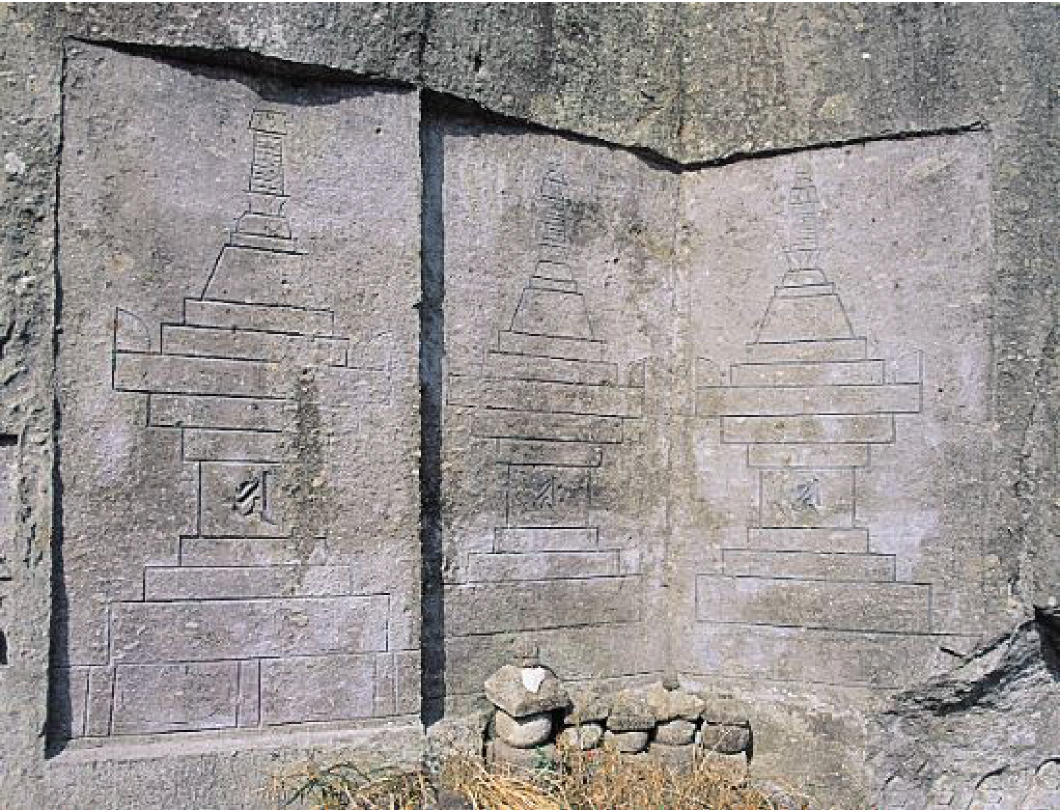
You are now standing in front of Sandai Houkoyuin-to, a paneled carving of three stupas. They were sculpted after a flat surface, 5 meters wide and 4 meters high, was scraped off of the cliffside. While it may seem small from where you are standing, it’s actually quite large.
What’s interesting about this sculpture are the inscriptions detailing the date of production and purpose. These are found between the middle and the right stupa. The letters are either carved or written in sumi ink. According to this information, the stupas were carved on March 13th, 1296. They were carved for a memorial service held forty-nine days after the death of a woman named Syojou.
Actually, there is another Houkyouin-to. It is located downstream, on the other side of a stone bridge. A description along with the sculpture notes that it was created on February 28th of the same year, in time for the memorial service held thirty-five days after Syoujou’s death.
These multiple stupas were dedicated to the same woman. One downstream, commemorating the thirty-fifth day after her death, and three upstream, honoring the forty-ninth day after her passing.
Isn’t this an amazing connection?
6.Gatsurin Dai-Bonji
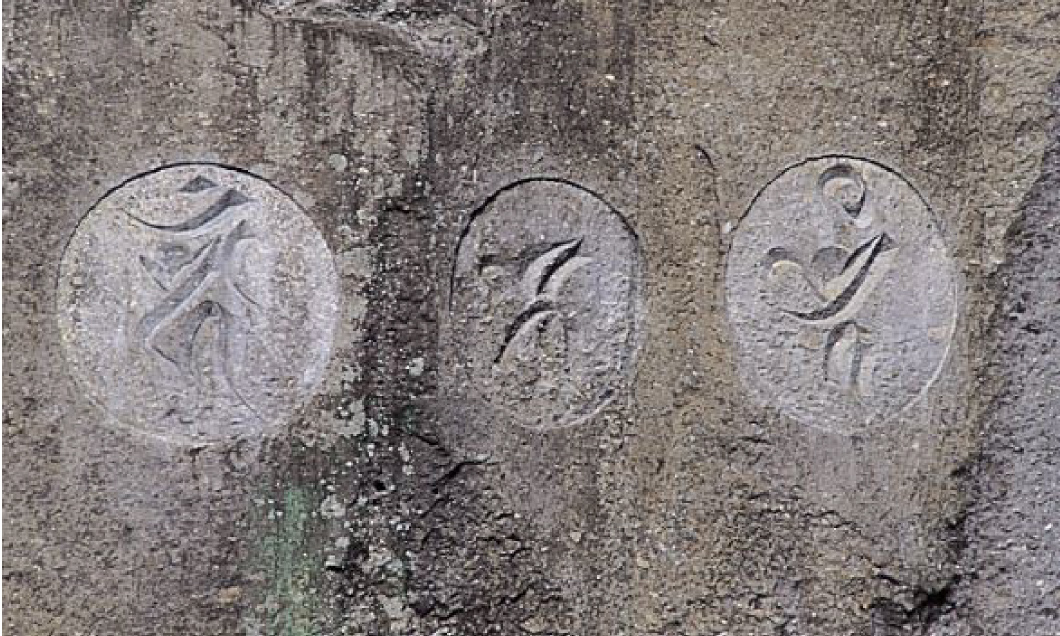
Across the river, a little to the right from your front, can you find three Sanskrit characters contained within circular representations of the moon? These are known collectively as Gatsurin Dai-Bonji. Bonji are Buddhist characters, in which each letter symbolizes revered figures such as Buddha. For example, the Sanskrit character on the left represents Fudo Myo-oh, one of the deities of Buddhism.
Although it may seem quite small from where you are standing, this carving is actually really large. The two circles on either side have a diameter of 175 centimeters. Aren’t they huge?
According to a record from around 1800, there were 5 Sanskrit characters carved on that wall. Currently, you can only find three of them, but take a close look at the right side. Look very carefully, and notice how the right side of the three sculptures is crumbled. The fourth and the fifth carvings once existed there.
The same record says that this Gatsurin Dai-Bonji was carved in 1264. Research tells us that a large comet appeared in the same year. Moreover, there were two lunar eclipses the year before. Scholars think these sculptures were carved as a prayer to prevent ominous events.
Unlike modern times, the moon and stars were clearly visible in the night skies of long ago.
7.Renkoku Itabi
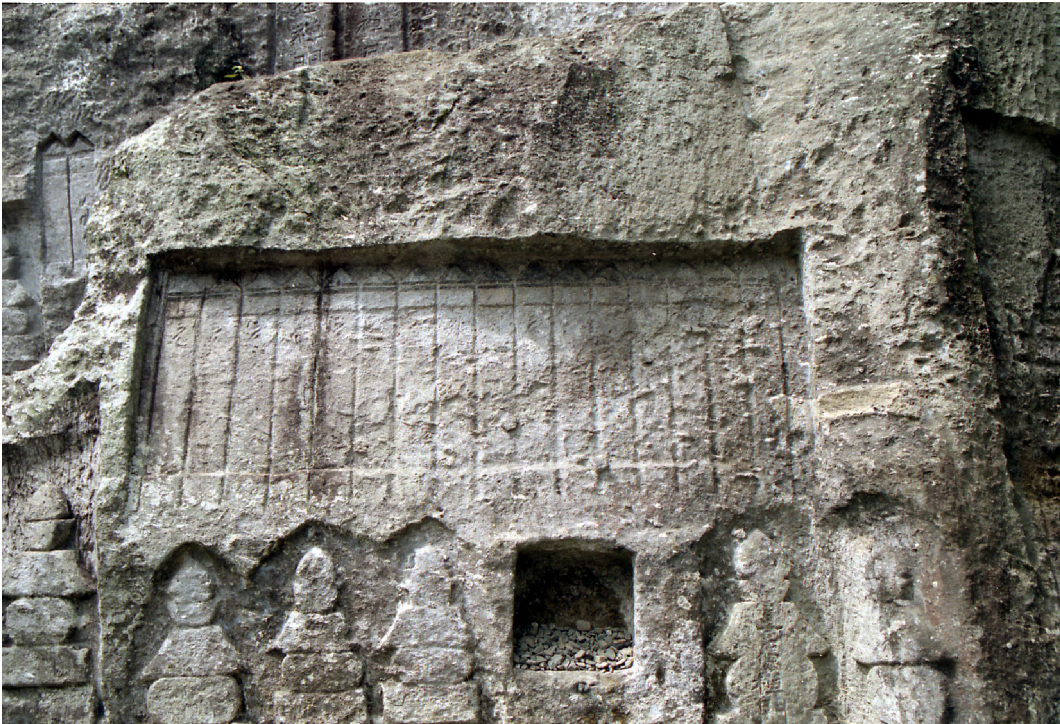
Down below Gatsurin Dai-Bonji, the three Sanskrit characters enclosed in circles, can you find a rectangular window-like frame? Measuring 250 centimeters across and 80 centimeters high, this carving is Renkoku Itabi.
Inside the frame, 16 Itabi, or vertical stupas, are sculpted in a row.
Itabi serve as a memorial to the dead, just like Hokyouin-to or Gorin-to stupas.
Unfortunately, the surface has now eroded away, and we cannot see what was inscribed on it. Not many Itabi have been sculpted here at Kiyomizu Magaibutsu, and it is unknown why 16 of them were carved continuously.
However, it is believed that these carvings were sculpted around the early 14th Century.
8.Magaibutsu Carved by Yoshida Chizan
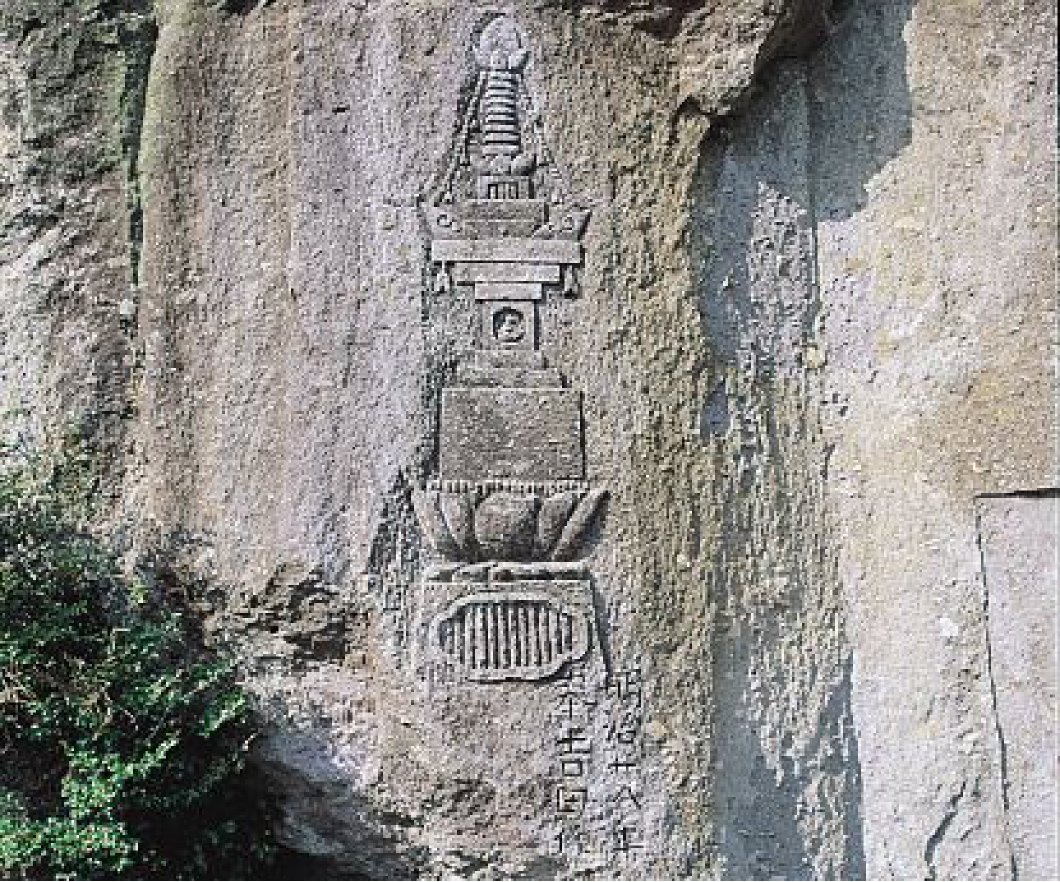
The last person to leave some Magaibutsu sculptures here was a traveling Buddhist priest named Yoshida Chizan.
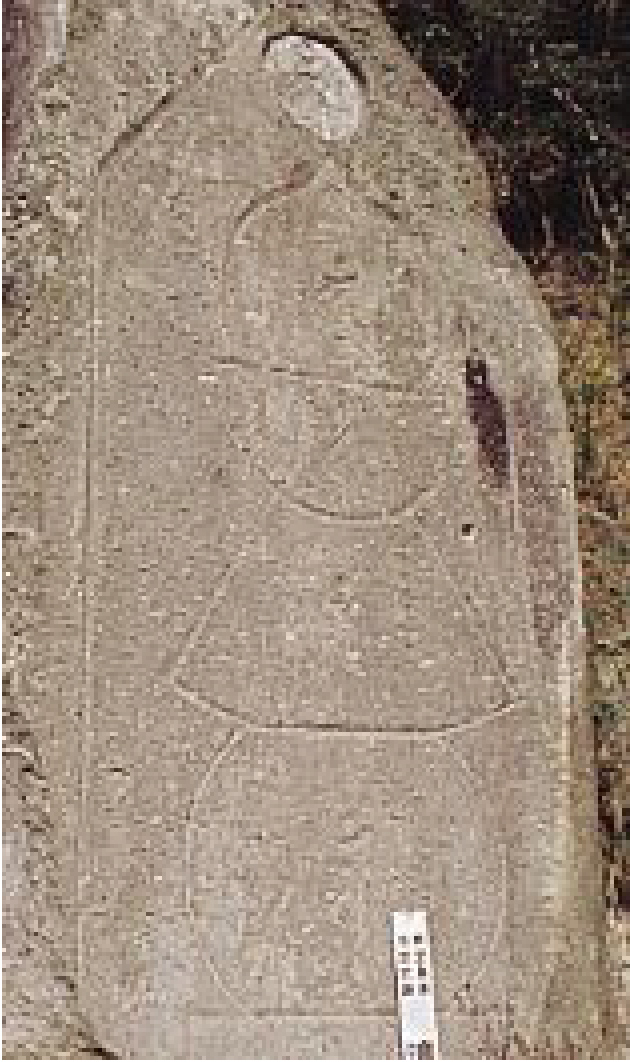
He carved three sculptures: Houkyouin-to, an 11-sided image of the Goddess of Mercy, called Juichimen Kannon, and an image of Amitabha Buddha. While most Kiyomizu Magaibutsu are engraved line carvings, Yoshida Chizan’s works are all reliefs.
The Juichimen Kannon Image and the Amitabha Image are located diagonally to the lower right of Gatsurin Dai-Bonji. Hidden behind the trees, you cannot see them from here. However, cross the river following the stepping stones leading to a rest house in the park. There, you will reach the foot of the cliffside, and you can see the images up close.
Houkyouin-to, the other work by Yoshida Chizan, is on the upper left side of Sandai Houkyouin-to, the square panel of three stupas which can be seen in front of where you are standing. Can you notice it? The left side of the sculpture may be hidden by a tree.
Born in Osaka, Yoshida Chizan was trained in Enryaku, Zenkou and Kiyomizu temples before coming to Kawanabe. After some time here, he left for Ohsumi town of Soo City, where he also sculpted an image of Buddha onto one of the cliffsides in the Tsukino district.
9.A View of Kiyomizu Magaibutsugun from Sakura-no-Yakata
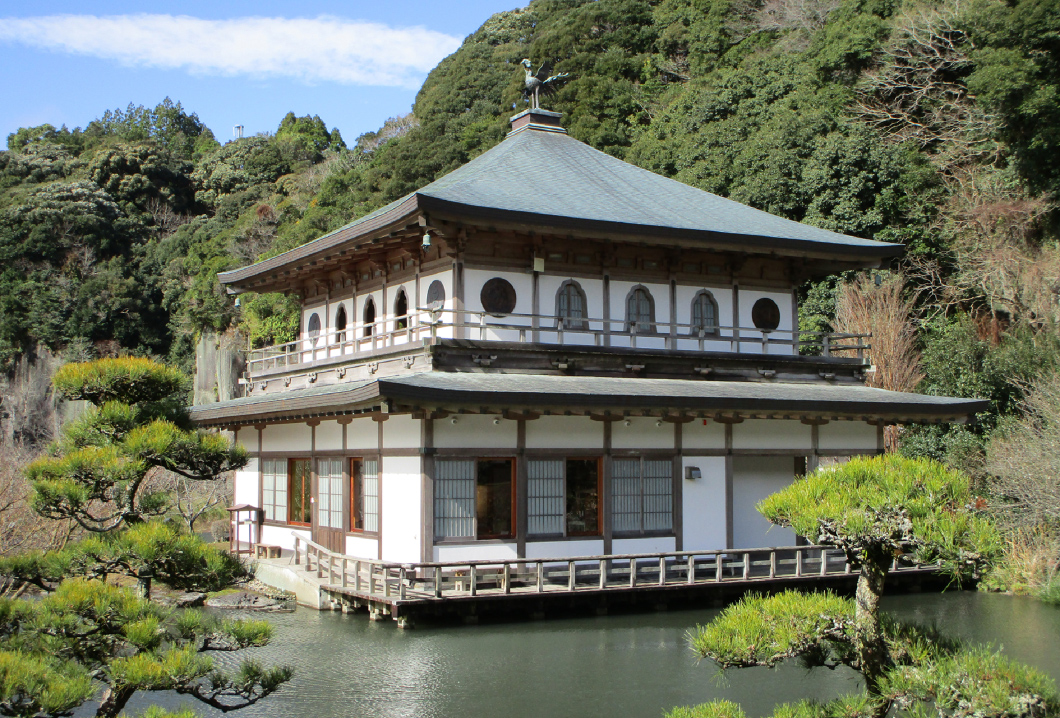
This building inside the park is called Sakura-no-Yakata.
From here, enjoy the views of the divine cliffside shining in the morning sunlight.
On this steep cliffside, 20 meters high and 400 meters wide, 202 sculptures have been carved.
Considering its scale and Buddhist value, it was registered as a Designated Cultural Property of Kagoshima Prefecture in 1959.
After all, it is a treasure of sculptures carved on natural rock faces. The whole rock of one of the Houkyouin stupas has fallen off the cliff. What’s more, two of the Sanskrit characters of Gatsurin Dai-Bonji have crumbled. Other sculptures are eroding away as well.
Most temples in Kagoshima Prefecture were destroyed due to a movement to abolish Buddhism during the Meiji Restoration in the late 19th Century.
That’s why Kiyomizu Magaibutsu has value as a historical site. It has inherited the religious beliefs of the days before this abolitionist movement.
We will work hard to preserve this meaningful treasure for future generations.